
Goals are the bedrock of any real achievement. They give you direction, sharpen your focus, and fuel your motivation, turning fuzzy daydreams into a concrete plan of attack. Think of a goal as your personal compass; it helps you navigate the daily noise and stay locked on what truly moves the needle.
The Hidden Power of Setting Clear Goals

Ever have one of those days where you're constantly busy but feel like you've accomplished nothing? It's a frustratingly common feeling, and it usually points to one culprit: a lack of clear direction. Without a destination in mind, it's all too easy to get bogged down in an endless cycle of tasks that eat up your time but don't get you anywhere meaningful.
This is exactly why setting goals is so crucial. It’s the difference between wandering around a forest and following a map to a specific viewpoint. You're still walking in both scenarios, but only one ensures you arrive where you actually want to be. Your goals are that map.
Goals Turn Ambition into Action
A vague wish like "I want to be more productive" or "I need to grow my freelance business" is a great start, but it's not a plan. It's an ambition without a backbone. A properly defined goal gives that wish the structure it needs to survive in the real world.
Here's a quick look at how this works in practice.
Key Reasons Goals Are Essential at a Glance
This table breaks down the core benefits, showing you exactly why taking the time to set goals is a non-negotiable step for anyone serious about progress.
| Benefit | Core Impact |
|---|---|
| Provides Clarity | Eliminates ambiguity and helps you understand precisely what you need to do next. |
| Boosts Motivation | Creates a tangible target that fuels your drive and keeps you going on tough days. |
| Enables Focus | Helps you say "no" to distractions and "yes" to tasks that align with your objective. |
| Measures Progress | Offers a clear benchmark to track how far you've come, making your wins visible. |
| Improves Decision-Making | Acts as a filter, making it easier to choose actions that support your ultimate aim. |
By defining your goals, you're essentially creating a powerful framework for success.
Creating a Framework for Success
Let's bring this to life with an example. A macOS developer who wants to "get better at coding" has a noble ambition, but it's too vague to act on.
A powerful, actionable goal would be: "Complete an advanced Swift UI course and build two portfolio-ready apps within the next three months." See the difference? This goal is specific, measurable, and has a deadline. It lays out a clear path forward.
Goals are the fuel in the furnace of achievement. Without them, you have nothing to burn, nothing to work toward, and no reason to push yourself.
Ultimately, understanding why goals matter is the first step toward working with intention. They provide the structure you need to channel your energy where it counts. For a deeper dive into structured methods, exploring different goal setting frameworks can give you proven strategies.
By defining what you want to achieve, you’re no longer just busy—you’re productive. And that clarity makes all the difference.
Why Your Brain Is Wired for Setting Goals

Ever noticed how the moment you decide you want something—say, a new M3 MacBook Pro or to land a project with a specific client—you start seeing it everywhere? That’s not just a coincidence. It's your brain kicking into gear.
The real power of goals comes from understanding that our brains are natural, goal-seeking machines.
Think of it like programming a GPS. Before you punch in a destination, your GPS is just a passive screen. But the second you give it a clear address, it instantly maps the best route, flags potential traffic, and starts guiding you, turn by turn. Your brain works in a remarkably similar way.
Your Brain's Built-In Focus System
Tucked away in your brainstem is a fascinating bundle of nerves called the Reticular Activating System (RAS). Its main job is to act as a bouncer, filtering the overwhelming flood of information your senses pick up every second. Without it, you’d be crippled by every sight, sound, and feeling.
When you set a clear, specific goal, you're essentially giving your RAS its marching orders. You’re telling it, "Hey, this is important—pay attention to it." It immediately starts scanning your environment for anything and everything relevant to that objective.
All of a sudden, that online course on Swift development or a networking event for Mac-based freelancers doesn't just fade into the background. It pops. Your RAS helps you cut through the noise and zero in on what truly matters for your ambition. It’s the neurological secret sauce behind why having a clear purpose feels so powerful.
The Dopamine Loop That Drives Motivation
But it's not just about focus. Your brain also has a built-in reward system that literally makes achieving goals feel good. When you make progress, even on a tiny milestone, your brain releases dopamine, a chemical messenger tied to feelings of pleasure and motivation.
This creates an incredibly powerful feedback loop. You set a small, doable task. You complete it. You get a little hit of dopamine. This reinforces the action and motivates you to tackle the next step, building a cycle of progress.
By breaking a large goal into smaller, manageable steps, you are not just making the project less daunting; you are creating more opportunities to trigger this natural motivation circuit in your brain.
This is exactly how you build momentum. Each small win shores up your confidence and makes the next step feel a little easier. It’s also why tracking your progress—whether in a notebook or an automatic tool like Chronoid—is so effective. It makes those small victories visible and keeps the dopamine flowing.
Building Self-Efficacy and Intrinsic Drive
Every single time you achieve a goal, you strengthen a core belief in yourself known as self-efficacy. This is your personal conviction that you have what it takes to handle challenges and get things done. The more you achieve, the stronger this belief gets, which in turn makes you more resilient when you inevitably hit a snag.
This belief fuels a deep, internal drive.
- Intrinsic Motivation: This is the drive to do something because it's personally rewarding, not for some external prize. Goals connect your daily grind to an outcome you genuinely care about.
- Personal Growth: Reaching for goals forces you to stretch your abilities and learn new skills, which is satisfying in its own right.
- Sense of Agency: Goals hand you the steering wheel, giving you a sense of control over your career and life. You become the architect of your own success.
This internal drive makes a huge difference in professional settings. In fact, employees who set ambitious goals are 14.2 times more likely to feel inspired at work. For goals to stick, they often need to become habits, so understanding how our brains work is key. You can make your plans much more effective by exploring good strategies for building healthy habits.
How Setting Goals Actually Makes You More Productive
It's one thing to know that goals give you a psychological boost, but it's another thing entirely to see that translate into real-world results. This is where the magic happens. Goals build a bridge from a fuzzy idea in your head to a concrete plan of action, cutting through the mental fog that so often leads to procrastination.
When you have a clear goal, you suddenly have a powerful filter for every decision you make. It turns your day from a series of random, reactive tasks into a focused mission. You’ve just handed yourself a tool for ruthless prioritization.
Taming the Endless To-Do List
Let's be honest, without a clear target, every little task can feel urgent. Answering that non-critical email, tweaking the font on your website, or reorganizing your desktop—it all feels like work. This is how busywork so effectively masquerades as productive work.
A specific goal forces you to ask one simple but powerful question for every single item on your list: "Does doing this move me closer to my objective?" If the answer is no, it gets pushed down the list, delegated, or deleted. It’s that simple.
Having a clear destination makes it infinitely easier to say 'no' to the detours and distractions that pop up along the way, and 'yes' to the activities that actually propel you forward.
This kind of intentional focus is the bedrock of getting meaningful work done. If you want to get better at this, a great next step is learning about the time management quadrant, which is a fantastic framework for separating what's truly important from what just feels urgent.
Allocating Your Most Valuable Resources
Your most limited resources aren't just the hours in your day—they're your energy and your focus. A well-defined goal ensures you invest these precious assets where they’ll deliver the biggest impact.
Think of your daily energy like a budget. Without a plan, you might blow it all on low-value activities first thing in the morning, leaving you running on fumes when it’s time for the deep work that really matters. Goals give you that spending plan.
- Morning Focus: You can block out your peak morning hours for the complex project that directly serves your main objective.
- Afternoon Admin: You can save the lower-energy admin tasks for that afternoon slump when your focus naturally starts to fade.
This is what working smarter, not just harder, actually looks like. It’s about matching your best energy to your most important work.
Creating a Clear Benchmark for Progress
How do you know if you're actually getting anywhere? Without a goal, "progress" is just a feeling. You might feel busy, but you have no objective way to know if you’re even moving in the right direction.
Goals give you that benchmark. If your goal is to increase your freelance income by 20% this quarter, you can track your earnings week by week. This creates an incredibly powerful feedback loop. You know exactly where you stand, what’s working, and what needs to change.
This isn't just theory; it’s backed by a ton of research. Studies show that giving workers specific targets can boost their output by around 15%. Interestingly, this jump happens whether the goals are self-assigned or set by a manager. You can read more about the connection between goal setting and motivation in some of the detailed research on the topic.
At the end of the day, goals are what turn a bunch of random actions into a focused strategy—one that helps you achieve what you want with far less wasted effort.
Common Goal Setting Mistakes and How to Avoid Them
Knowing why goals matter is the easy part. Actually setting goals you can stick with? That's a different beast entirely. So many good intentions fall flat, not because of a lack of effort, but because the goals themselves were broken from the get-go. Let's break down the common traps so you can sidestep them.
One of the biggest culprits is setting vague or ambiguous objectives. A goal like “get better at marketing” or “be more productive” sounds nice, but it’s completely unhelpful. It's like hopping in a cab and just saying "drive south"—you'll move, sure, but you probably won't end up where you actually want to be.
This kind of ambiguity leaves you with no real way to measure success or even figure out what to do next. When there's no finish line in sight, motivation just evaporates. The fix? Get ruthlessly specific.
The Problem of Vague Ambitions
Instead of a fuzzy wish, you need a concrete outcome. This one tweak is what turns a daydream into a real project.
- Vague Goal: “Get healthier.”
- Specific Goal: “Walk for 30 minutes, five days a week, and drink two liters of water daily for the next month.”
- Vague Goal: “Grow my freelance business.”
- Specific Goal: “Land two new clients with a project value of at least $2,500 each by the end of this quarter.”
See the difference? That level of clarity gives your brain something tangible to work towards, making it a whole lot easier to map out your next steps and see if you're actually making headway.
Another classic mistake is setting too many goals at once. Ambition is fantastic, but trying to launch a new product, learn Swift, and train for a marathon all at the same time is a surefire recipe for burnout. Your focus is a finite resource. Spread it too thin, and you accomplish nothing.
The art of achieving your goals is often found in the discipline of choosing which ones not to pursue right now. Focus is a strategic decision to apply concentrated effort.
To get around this, you have to prioritize. Pick just one to three major goals for a set period, like a quarter. By channeling all your energy into a few key areas, you build real momentum. Nail one, and you can roll that win and a fresh dose of confidence right into the next objective.
Breaking Down Overwhelming Goals
Finally, people often stumble because their goal is just too big. An objective like “write a book” feels so massive it’s paralyzing. Staring up at a mountain like that, it's no wonder procrastination suddenly looks like a great idea.
The key is to break that giant goal down into a series of small, non-scary steps. Think of it like building a house one brick at a time. You don't obsess over the finished mansion; you just focus on laying the very next brick perfectly.
Example Goal Breakdown
- Massive Goal: Build a new portfolio website.
- Monthly Milestone: Finalize design mockups and select a technology stack.
- Weekly Task: Create the wireframe for the homepage.
- Daily Action: Sketch three layout ideas for the "About Me" section.
This process transforms a daunting mission into a simple daily checklist. Each tiny task you tick off delivers a little hit of dopamine, fueling your motivation to keep going. When you avoid these common blunders, you’re setting yourself up for a win before you even start.
How to Create Your First Measurable Goal
Knowing why goals matter is one thing, but actually building one that works is a whole different ballgame. This is where the rubber meets the road. Instead of just having a vague ambition, you need a solid framework to turn that fuzzy wish into a concrete plan of attack. A well-built goal is like a blueprint for your success, telling you exactly what to build and when it needs to be done.
One of the most battle-tested methods for this is the SMART framework. It's a simple but incredibly effective checklist that forces your goals to be clear, focused, and trackable from day one.
Let’s break down what each part really means.
Use the SMART Framework to Build Better Goals
Think of SMART less like a strict rulebook and more like a set of guardrails to keep your ambitions from veering off a cliff. Each letter is a quick test to make sure your goal is built to last.
- S – Specific: Get crystal clear. What exactly do you want to accomplish? Who’s involved? A vague goal is an abandoned goal.
- M – Measurable: How will you know you’ve won? You need hard numbers or clear milestones to track your progress and keep the motivation high.
- A – Achievable: Your goal should stretch you, but it shouldn't be pure fantasy. Aiming too high too fast is just a recipe for burnout and frustration.
- R – Relevant: Why does this matter? The goal has to align with your bigger picture, whether that's your career, your studies, or your personal growth.
- T – Time-bound: Give it a deadline. A finish line creates a healthy sense of urgency and prevents your goal from getting lost in the “someday” pile.
Let's see this in action. Imagine a freelance macOS developer whose goal is simply to "get more clients." It's a nice thought, but it’s flimsy. It’s vague, you can't measure it, and there's no end date.
Here’s how we can rebuild it with SMART:
Specific: I will land three new clients for my macOS development services. Measurable: Each client project must be worth at least $5,000**, for a total of **$15,000 in new business. Achievable: Based on my portfolio and current network, I can realistically connect with enough prospects to close three deals. Relevant: This directly supports my bigger goal of increasing my annual freelance income by 30%. Time-bound: I will get this done by the end of the current quarter (e.g., by March 31st).
Suddenly, "get more clients" becomes "Land three new macOS development clients with a minimum project value of $5,000 each by March 31st." Now that's a plan you can execute.
The journey from a messy, undefined problem to a clear, successful outcome often looks like this.
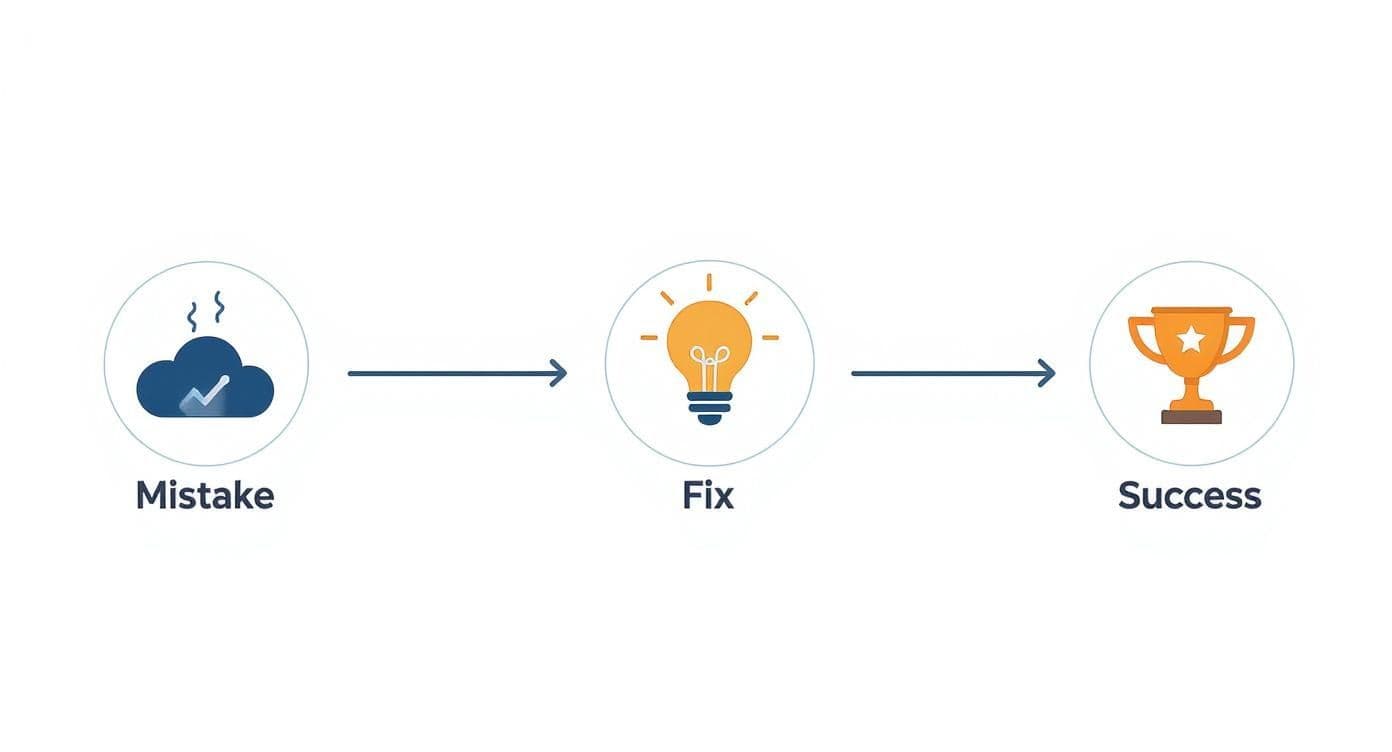
You spot the mistake (a vague goal), apply a fix (the SMART framework), and create the clarity needed to actually achieve something.
Consider OKRs for Ambitious Targets
While SMART is fantastic for specific, tactical goals, sometimes you need a framework for bigger, more ambitious targets. That’s where OKRs (Objectives and Key Results) come in. They’re perfect when you have a big-picture vision and need to map out how you’ll get there.
- Objective: This is your big, hairy, audacious goal. It’s the inspirational "what." It should feel significant and get you fired up.
- Key Results: These are the measurable metrics that prove you're on track to hit the objective. They answer the question, "How will I know I'm getting there?" You'll usually have three to five of these for each objective.
OKRs neatly separate your ultimate destination (the Objective) from the real-world milestones that tell you you're making progress (the Key Results).
Let's take a student using a Mac for their studies.
- Objective: Absolutely crush my final-year statistics course and lock in a top grade.
- Key Results:
- Score 90% or higher on all three major exams.
- Turn in 100% of the weekly assignments before they are due.
- Log ten focused hours of study time each week, tracked with an app like Chronoid.
This approach directly links the daily grind of studying and homework to a much larger, more meaningful purpose. If you're looking for more ideas, check out these detailed examples of setting goals at work—many of the same principles apply just as well to personal and academic projects.
Whether you lean toward SMART or OKRs, the underlying principle is the same: clarity is king. When you translate your ambitions into well-defined targets, you create a roadmap, making it infinitely easier to focus your energy and see your progress toward a meaningful finish line.
How to Track Progress and Stay Motivated

Think of it this way: a well-defined goal is your destination, but consistent tracking is the GPS that keeps you on course. Without some way to see how you're doing, even the sharpest goal can feel distant and, eventually, fade into wishful thinking. Making your progress visible isn't just a nice-to-have; it's what fuels your motivation for the long haul.
Tracking turns an abstract idea into something real and measurable. It gives you the honest feedback you need to celebrate small victories, spot what's slowing you down, and make smart tweaks to your game plan. This is a huge part of why goals important—they give you a yardstick to measure your daily efforts against.
Making Your Progress Visible
You don’t need some hyper-complex system to get started. The best method is whatever you'll stick with. Honestly, consistency trumps sophistication every time.
- Simple Journaling: Just take five minutes at the end of the day to jot down what you accomplished. This simple habit keeps your goal front and center and reinforces the day's wins.
- Spreadsheets: If your goals are numbers-driven—like tracking freelance income or logging study hours—a basic spreadsheet is perfect for spotting trends over time.
- Dedicated Apps: For macOS users, an automatic time tracker like Chronoid can handle the heavy lifting. It quietly logs how you spend your time on different apps and websites, no manual start/stop timers needed.
Seeing your time laid out clearly helps you instantly connect your daily actions to your bigger ambitions. It’s no longer a guess where the hours went.
Let Data Be Your Accountability Partner
When you track consistently, you get impartial feedback. It’s no longer about feeling like you were productive; you can actually see the data. This feedback loop is your secret weapon for making steady improvements. If you want to dig deeper into building better work habits, these time management best practices are a great next step.
Tracking is the process of turning your daily actions into a story of progress. When you see how far you've come, you build the momentum and belief needed to keep going.
By checking in with your progress regularly, you gain the clarity to know when to push harder and when it's time to rethink your approach. This keeps your goals from getting lost in the shuffle of a busy life. At the end of the day, this commitment to tracking is what separates a fleeting ambition from a goal you actually achieve.
Got Questions About Setting Goals?
Even with the best intentions, putting goal-setting theory into practice can get tricky. You understand why goals are important, but then the real-world questions start to creep in. Let's tackle some of the most common hurdles people face when they get down to business.
Think of this as your go-to guide for those "what do I do now?" moments.
What's the Difference Between a Goal and a To-Do List?
This is a big one, and confusing the two is a classic mistake. A to-do list is all about the small, concrete steps you take every day. A goal is the bigger, meaningful prize you’re working toward.
For example, "write 500 words" is a task. It belongs on your to-do list. The goal behind it is something much larger, like "Finish the first draft of my novel in three months." Your goals give purpose to your daily grind and stop you from getting lost in busywork.
Your to-do list is the how. Your goal is the why. One is pretty useless without the other. Tasks without a goal are just spinning your wheels, and a goal without tasks is just a dream.
Getting this right helps you see a clear line from the work you're doing right now to that awesome finish line you want to cross.
How Many Goals Should I Set at Once?
I know it’s tempting to try and fix everything in your life or business all at once, but that's a surefire way to get nothing done. Juggling too many goals just splits your attention and burns you out, making you less likely to succeed at any of them.
The secret is to be ruthless about what matters most right now. Aim for just one to three major objectives at a time, maybe per quarter.
- Laser Focus: Putting all your energy into a couple of key targets builds incredible momentum.
- Less Overwhelm: Fewer goals mean less mental clutter and less time spent switching gears.
- Higher Success Rate: You give yourself a much better shot at actually winning when you aren't spread too thin.
Once you knock one big goal out of the park, you can roll that amazing feeling of accomplishment right into the next one. It’s way more effective than trying to do it all simultaneously.
What If I Don't Reach My Goal?
First off, missing a goal isn't a personal failure. It's just data. The absolute worst thing you can do is throw in the towel. Instead, see it as a chance to learn what went wrong and come back smarter.
Take a minute and do a quick post-mortem. Ask yourself a few honest questions:
- Was the goal a bit crazy to begin with? Sometimes our ambition gets ahead of reality.
- Was the deadline too tight? Did I really give myself enough runway to get this done?
- What curveballs did life throw at me? Acknowledge the things you couldn't control.
- Where did my own system fall apart? Pinpoint the habits or steps that failed you.
Use the answers to adjust your game plan. Maybe you need to tweak the original goal, break it down into even smaller pieces, or set a completely new objective based on what you just learned. Every attempt—win or lose—gives you the insight to get better next time.
Ready to stop guessing and start making real progress? Chronoid automatically tracks your work on your Mac, so you can see exactly where your time is going, cut out distractions, and focus on your most important goals. Start your free 30-day trial and finally get the clarity you need.