
The real difference between deep work vs shallow work boils down to two things: value and brainpower. Deep work is when you’re fully locked in, concentrating on a tough task that creates something new and valuable. It pushes your skills to their limits. Shallow work, on the other hand, is all the low-value, logistical stuff you can do while distracted—it doesn’t require much mental heavy lifting.
Defining Deep and Shallow Work
Getting a handle on this distinction is the first real step toward taking back your focus and actually producing work you’re proud of. These aren’t just opposites; they’re entirely different gears for your brain and your career.
Think of deep work as your prime time. It’s the uninterrupted block you carve out to write a complex report, hammer out a new business strategy, or finally learn that tricky new software. This is the stuff that can’t be easily passed off to someone else, and it’s directly tied to your growth and tangible results.
Shallow work is the necessary evil. It’s the administrative glue holding your job together—firing off routine emails, sitting in status update meetings, or organizing your digital files. These tasks keep the lights on, but they almost never lead to a breakthrough.
This infographic lays out the core differences in a really clear way.
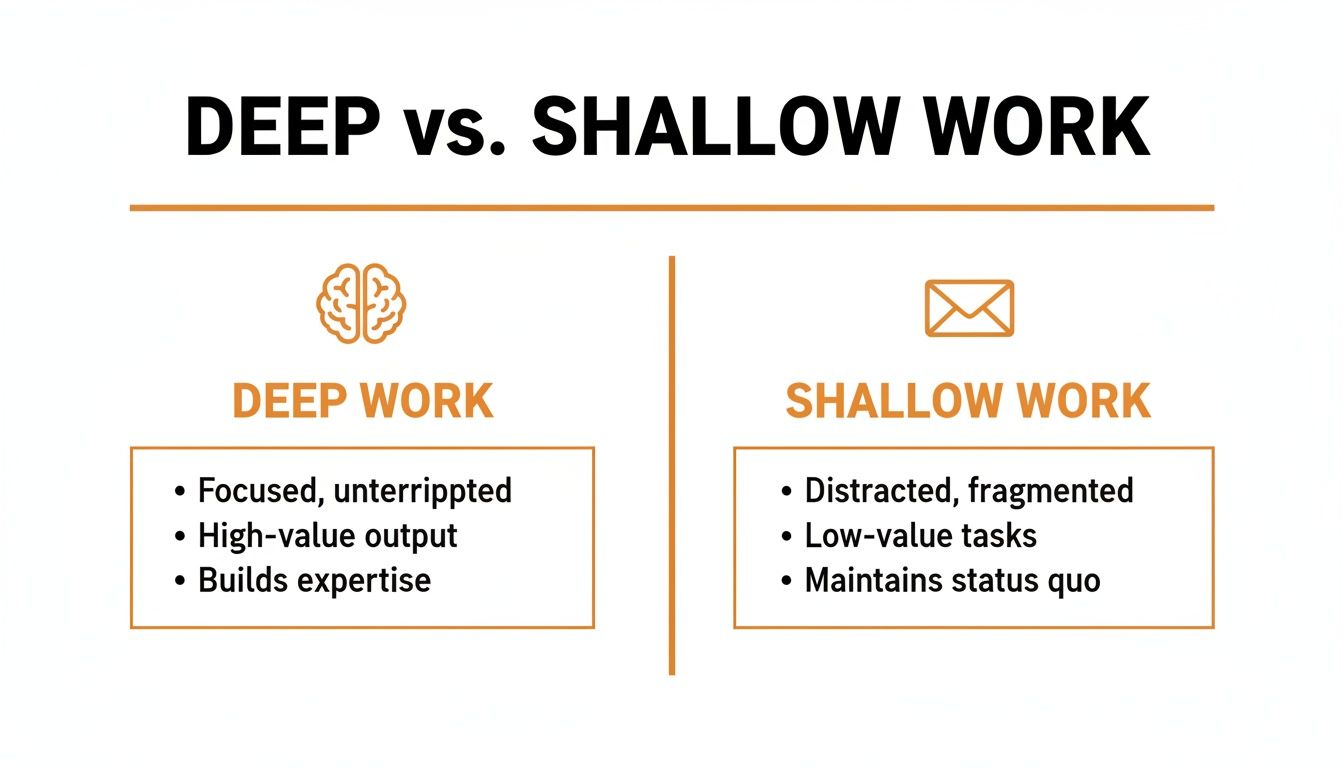
As you can see, deep work is where you build real expertise and create lasting value. Shallow work? It mostly just keeps things from falling apart.
The Modern Imbalance
Here’s the problem most of us face: shallow work is a bully. It elbows its way into our calendars and takes over. The average full-time employee only gets about 11.2 hours per week of real, productive deep work, despite working a 47.6-hour week. That means less than 25% of their time is spent on high-impact activities.
The ability to perform deep work is becoming increasingly rare at exactly the same time it is becoming increasingly valuable in our economy. This is a good thing for those who cultivate this skill.
This imbalance is a huge issue. Our potential for making genuine progress gets drowned out by the constant hum of just being “busy.” The goal isn’t to get rid of shallow work—that’s impossible—but to put it in its place so it stops hijacking your most valuable hours.
Comparing Key Attributes
To really bring these concepts to life, it helps to see them side-by-side. The table below offers a quick snapshot to help you start categorizing your own daily tasks. Once you start seeing the difference, you can learn how to implement high-level thinking time to make deep work a regular part of your routine.
Deep Work vs Shallow Work at a Glance
| Attribute | Deep Work | Shallow Work |
|---|---|---|
| Cognitive Strain | High (mentally demanding) | Low (can be done on autopilot) |
| Value Creation | Creates new, high-quality value | Tends to maintain existing value |
| Distraction Level | Requires zero distractions | Often performed while distracted |
| Skill Building | Pushes and improves your skills | Does not require new skills |
| Example Tasks | Strategic planning, coding, writing | Answering emails, scheduling |
Having this clear contrast makes it easier to audit your own time and see where the hours are really going. The next step is to consciously shift the balance.
The Hidden Costs of Too Much Shallow Work
A day packed with shallow tasks can feel incredibly busy, but this feeling is often just an illusion of productivity. And it comes with some serious hidden costs. While you can’t eliminate shallow work completely, letting it take over your schedule drains your most valuable asset: your focused attention. This constant fragmentation of your day isn’t just inefficient; it creates problems that ripple through your performance and well-being.
The biggest issue is cognitive drain. Every time you switch from a tough problem to answer a quick email or Slack message, you’re engaging in context switching. That mental gear shift isn’t free. It eats up energy and leaves you feeling wiped out, even if you haven’t accomplished much of substance. A day full of these micro-interruptions can honestly be more exhausting than a few hours of intense, deep concentration.

This constant state of distraction also torpedoes the quality of your work. When your attention is split, your brain can’t process information as deeply, which is when mistakes start to creep in.
The Rise of Errors and Stress
When a workplace values quick responses over focused results, you start to see a lot more preventable errors. Think about it: a hastily written email might have typos or unclear instructions, which just creates more back-and-forth later. A rushed data entry task could lead to a flawed report that takes hours to fix. These aren’t just small annoyances; they’re the direct result of a work style that puts speed before thoughtfulness.
On top of that, the pressure to be constantly available is a huge source of workplace stress. That nagging feeling that you have to jump on every notification creates a persistent, low-level anxiety. It makes it nearly impossible to detach and actually concentrate, trapping you in a never-ending reactive cycle.
Interruptions from shallow work exact a massive toll on productivity, equivalent to losing nearly an entire workday weekly. The average knowledge worker faces disruptions every 11 minutes, taking 25 minutes to refocus—totaling 6.52 hours lost per week.
This constant frenzy doesn’t just waste time; it also spikes stress levels by as much as 27% and increases error rates by 15-20%, according to extensive research. You can dig into more of the data on how this affects productivity in Hubstaff’s findings on the true cost of workplace interruptions.
Stagnation and Lost Opportunities
Maybe the most damaging long-term cost of too much shallow work is professional stagnation. Deep work is the engine for skill development and innovation. It’s during those focused blocks of time that you learn new things, solve complex problems, and create the kind of high-value work that gets you noticed.
When your calendar is perpetually booked with meetings, emails, and admin tasks, you simply have no time left for the activities that move your career forward. You end up just maintaining the status quo instead of pushing boundaries. Over months and years, this creates a major skill gap between you and your peers who fiercely protect their time for deep, meaningful effort.
Let’s break down the key costs:
- Decreased Cognitive Capacity: Constant task-switching burns through your mental energy, making it harder to tackle challenging work when you finally get the chance.
- Increased Error Rate: A fragmented focus leads to more mistakes, creating rework for you and everyone on your team.
- Elevated Stress and Burnout: The “always-on” culture driven by shallow work is a fast track to mental and emotional exhaustion.
- Career Stagnation: Without dedicated time for deep work, your skills get rusty, and you miss out on opportunities to make a real impact.
Ultimately, a workplace culture that celebrates “busyness” over tangible results is unknowingly trading long-term innovation and growth for short-term responsiveness. The real difference between deep work vs shallow work isn’t just about the task at hand—it’s about the future it creates for you and your organization.
Why Deep Work Is Your Career’s Secret Weapon
We all know what it feels like to have a busy day—back-to-back meetings, a flooded inbox, constant pings. You feel productive, but what did you actually accomplish? A day packed with shallow tasks rarely moves the needle.
In contrast, making deep work a priority is one of the most powerful skills you can build. It’s the engine that drives real growth, letting you produce high-quality work that truly sets you apart.
This is where you master your craft. Consistent deep work puts you on the fast track to learning, helping you tackle tough challenges and pick up valuable new skills far quicker than you would with a scattered mind. By dedicating focused time to research and original thinking, you can excel at cultivating thought leadership and seriously boost your career.
From Busywork to Breakthroughs
Innovation doesn’t happen between email replies or during a status update. Real breakthroughs come when you have uninterrupted mental space to connect ideas, dig into complex information, and think critically. Deep work carves out that essential space.
When you block off focused time for your most important projects, the quality of your work skyrockets. You stop just checking off boxes and start creating work that is thoughtful, polished, and genuinely impactful. It’s the difference between clearing an inbox and writing a strategic plan that will define your company’s next year.
“The ability to perform deep work is becoming increasingly rare at exactly the same time it is becoming increasingly valuable in our economy.” - Cal Newport, Author of Deep Work
This scarcity is precisely what makes deep work a career superpower. In a world where most people are stuck in a reactive loop of shallow tasks, the person who can consistently produce high-value work through deep focus has a massive advantage.
Get Ahead Faster and Find More Fulfillment
The connection between deep work and career advancement is crystal clear. The high-quality, innovative work you produce during these focused sessions is what gets you noticed. It builds a reputation for competence, reliability, and strategic thinking—all the things that lead to promotions and better opportunities.
But it’s not just about the external rewards. Deep work also brings a profound sense of personal satisfaction. Tackling challenging tasks that stretch your abilities creates a genuine feeling of accomplishment and pride. This sense of making a real contribution is a huge driver of job satisfaction, transforming work from a daily grind into a meaningful pursuit.
The numbers don’t lie. Professionals who regularly practice deep work achieve 2-3 times more skill progression each year compared to those stuck in shallow tasks. And it’s not just individuals—Gallup’s research shows that teams prioritizing deep work see 21% higher profitability and 17% higher productivity. They’re focused on what truly matters, not just staying busy.
Build Your Competitive Edge
Ultimately, choosing between deep work vs shallow work is a strategic decision. If you master deep work, you’re building a career defined by growth and impact. If your organization fosters a culture of focus, it gains a serious competitive advantage.
Here’s what that looks like in practice:
- Master Skills Faster: You learn complex things more quickly, positioning yourself as an expert.
- Produce Elite-Level Work: Your output becomes more creative, insightful, and has fewer errors.
- Drive Real Innovation: You have the mental bandwidth to solve bigger, more complex problems.
- Increase Your Professional Value: Your contributions become more significant and much harder to replicate.
By intentionally structuring your days to protect and prioritize deep work, you’re not just managing your time better—you’re investing directly in your future. You’re making the shift from being busy to being truly effective.
How to Structure Your Day for Maximum Focus
Knowing the difference between deep and shallow work is the easy part. The real challenge is carving out the space to actually get focused work done. The goal here is to shift from a chaotic, reactive schedule to one that’s deliberate and structured. Instead of letting your inbox run your day, you design your day around what truly matters.
This takes a clear strategy. Thankfully, author Cal Newport lays out four distinct philosophies for weaving deep work into your life. The right one for you will depend entirely on your job, your personality, and just how much control you have over your own schedule.
The Four Deep Work Philosophies
There’s no one-size-fits-all approach. A freelance writer operates under completely different constraints than a corporate manager. The trick is to find a system you can actually stick to, because consistency is what builds the deep work habit.
Let’s break down the four main ways you can approach this:
-
The Monastic Philosophy: This is the most intense, all-in method. You basically eliminate or radically slash all your shallow obligations to dedicate almost all of your professional time to one single, high-value goal. Think of a professor on sabbatical to write a book or a developer holed up to build a new product from scratch. It offers incredible focus but is completely unrealistic for most of us who need to collaborate and respond to others.
-
The Bimodal Philosophy: This approach splits your time into two clear modes: deep and shallow. You might dedicate three full days a week to pure, uninterrupted deep work, with the other two reserved for meetings, emails, and all the other collaborative stuff. This is a great fit for people who need long stretches of focus but still have to be available. It just requires a lot of planning and a workplace that supports it.
-
The Rhythmic Philosophy: This is easily the most popular and practical method for most people. The rhythmic approach is all about making deep work a simple, regular habit. You just schedule a consistent block of time—say, 90 minutes to two hours every single morning—for focused work. By turning it into a ritual, you take the friction out of getting started and make focus a natural part of your routine.
-
The Journalistic Philosophy: This one is the most flexible, but it’s also the hardest to pull off. It’s about grabbing any pocket of free time you can find and instantly switching into deep work mode. A meeting gets canceled and you’ve got a surprise hour? You dive right in. This requires serious discipline and the ability to shift gears without any warm-up, making it best for people with highly unpredictable schedules.
Building Your Schedule with Time Blocking
Once you’ve picked a philosophy that feels right, the next step is to make it real with time blocking. This is a simple but powerful technique where you divide your entire day into blocks of time and assign a specific task to each one. It’s about proactively telling your time where to go instead of wondering where it went.
Here’s how to put it into practice:
- Schedule Deep Work First: Before your week even starts, open your calendar and block out your deep work sessions. Treat these appointments with the same respect you’d give to a meeting with your boss. They are non-negotiable.
- Batch Your Shallow Tasks: Instead of letting emails and Slack messages interrupt you all day, schedule two or three dedicated 30-minute blocks to deal with them all at once. Do the same for any administrative or low-impact tasks.
- Use a Focus Timer: During your deep work blocks, a tool like the Pomodoro method can keep you on track. Working in focused sprints with built-in breaks is a fantastic way to maintain high concentration without burning out. A dedicated Pomodoro Timer can really help structure these sessions effectively.
By blocking out your time, you’re not just creating a to-do list; you’re giving every minute a job. This simple shift in perspective can fundamentally change your relationship with your work, transforming your calendar from a record of obligations into a strategic plan for success.
A Sample Weekly Schedule Structure
Sometimes seeing it laid out makes it all click. Here’s a sample schedule based on the Rhythmic philosophy, which does a great job of balancing focused work with the realities of a collaborative role.
| Time | Monday | Tuesday | Wednesday | Thursday | Friday |
|---|---|---|---|---|---|
| 9:00 - 11:00 AM | Deep Work Block | Deep Work Block | Deep Work Block | Deep Work Block | Deep Work Block |
| 11:00 - 12:00 PM | Email/Slack Batch 1 | Team Meeting | Email/Slack Batch 1 | Project Sync | Email/Slack Batch 1 |
| 12:00 - 1:00 PM | Lunch Break | Lunch Break | Lunch Break | Lunch Break | Lunch Break |
| 1:00 - 3:00 PM | Collaborative Work | Project Meetings | Collaborative Work | Client Calls | Weekly Review |
| 3:00 - 3:30 PM | Email/Slack Batch 2 | Email/Slack Batch 2 | Email/Slack Batch 2 | Email/Slack Batch 2 | Finalize Tasks |
| 3:30 - 5:00 PM | Flexible/Shallow | Flexible/Shallow | Flexible/Shallow | Flexible/Shallow | Plan Next Week |
This structure guards your high-energy morning hours for the tough, cognitive tasks and neatly contains the shallow stuff into specific windows. If you communicate this schedule to your team, you set clear expectations about when you’re available, protecting your focus time without becoming a bottleneck. This kind of intentional design is the first real step toward taking back your focus and producing work that matters.
Practical Strategies to Minimize Distractions
Having a good schedule is one thing, but you also need a strong defense against the constant flood of distractions. If you want deep work to win out over shallow work, you have to build systems that protect your focus without you even thinking about it. It’s all about creating a workspace—both physical and digital—where concentration is the easiest option.

The first step is to tame your digital world. Our tools are built to grab our attention, but with a few simple tweaks, you can take that control back.
Mastering Your Digital Environment
Your digital setup is probably ground zero for shallow work interruptions. Thankfully, a few small adjustments can make a world of difference.
Start by killing all non-essential notifications on your computer and phone. That means alerts from email, social media, and news apps. Let’s be honest: if it’s a true emergency, someone will call.
Next, set some ground rules for communication. You can create “office hours” on tools like Slack or Teams, letting colleagues know when you’re available for quick chats versus when you’re head-down in a deep work block. For more on this, check out our guide on how to improve focus at work for more practical tips.
- Use Email Filters: Set up rules to automatically sort incoming mail. This keeps your main inbox clear for what’s important and lets you tackle less urgent messages in one go.
- Close Unnecessary Tabs: A cluttered browser is a cluttered mind. Get in the habit of closing any tab that isn’t directly related to what you’re working on right now.
- Build a Focus Toolkit: Find apps that block distracting sites or offer a clean, minimalist writing space.
Each of these small changes adds a tiny bit of friction to getting distracted, making it that much easier to stay in the zone.
Performing a Shallow Work Audit
Before you can drain the swamp of shallow tasks, you have to know what’s in it. A shallow work audit is a straightforward but incredibly revealing exercise for identifying where your time is really going.
For one full week, keep a running log of your activities. At the end of each day, categorize every task as either deep or shallow. I guarantee you’ll be surprised by how much time you spend on things that don’t move the needle.
A shallow work audit isn’t about feeling guilty. It’s about gathering cold, hard data to design a better future. It turns that vague feeling of “being busy” into a concrete list of tasks you can start to eliminate, automate, or delegate.
Once you have your list, run each shallow task through these questions:
- Can I eliminate it? Is this weekly report or standing meeting actually necessary?
- Can I automate it? Could a simple script or a tool handle this repetitive work?
- Can I delegate it? Is there someone else on the team who could do this better or faster?
- Can I batch it? Can I knock out all my administrative tasks in one focused hour?
This audit gives you a clear roadmap for cutting through the noise. It also makes it much easier to say “no” to requests that don’t line up with your real priorities. When you have data showing that your focused time is a finite and valuable resource, protecting it becomes a no-brainer. By methodically cutting back on these low-impact activities, you free up the space you need for the deep work that truly matters.
How to Measure Your Deep Work Progress

If you’re serious about mastering the balance between deep work vs shallow work, you have to stop guessing and start measuring. It’s all too easy to feel productive when you’re just spinning your wheels on low-impact tasks. Tracking your time is the only way to get an honest look at where your day truly goes.
The simplest way to start is by categorizing your activities. At the end of each day, take a few minutes to review your to-do list or calendar and label each task as either “deep” or “shallow.” This quick audit immediately shows you your current ratio and gives you a baseline to build from.
Using Tools for Objective Insights
Manual tracking is a fine start, but let’s be honest, it can be a chore. This is where modern tools come in, offering automated and much more objective insights. For anyone on a Mac, an automatic time tracker like Chronoid can completely change the game. It runs quietly in the background, logging the apps and documents you’re working on, so you get accurate data without ever having to hit a start/stop button.
This kind of data takes the guesswork out of productivity. You can see at a glance which projects command your focus and, more importantly, where shallow work is quietly eating up your time. It transforms that vague feeling of “I wasn’t very productive today” into concrete facts you can actually do something about.
Setting Goals and Making Adjustments
Once you have some data, you can start setting realistic goals. The aim isn’t to kill off shallow work entirely—that’s just not practical. A much better approach is to set a small, achievable target. For instance, you could aim to increase your deep work time by 20% over the next month.
The real point of tracking isn’t to hit a perfect score. It’s about creating a feedback loop. When you review your data each week, you spot patterns, celebrate small wins, and can make smarter tweaks to your schedule and habits.
This process of continuous improvement is what builds a sustainable deep work practice. It’s not a one-and-done fix; it’s an ongoing process of refining how you protect your most valuable asset: your attention. Keeping a simple log of these weekly check-ins can be incredibly powerful. Our guide on keeping a daily work journal offers a great framework for this.
Here’s a simple structure you can use for a weekly review:
- Review the Data: What was my deep-to-shallow work ratio this week?
- Identify Wins: When was I most focused? What helped me get into that state?
- Find Bottlenecks: What were my biggest distractions or time sinks?
- Set a New Goal: What’s one small change I can commit to next week to improve my ratio?
This iterative cycle ensures you’re always moving forward, building your capacity for deep work one focused session at a time.
Frequently Asked Questions
It’s one thing to understand the theory behind deep work, but putting it into practice in the real world comes with its own set of challenges. Here are answers to some of the most common questions that pop up when you start making the shift.
How Can I Practice Deep Work In A Loud, Open-Plan Office?
This is a tough one, but you have more control than you think. Your best first move is to get a pair of high-quality, noise-canceling headphones. They create a personal focus zone and act as a powerful “do not disturb” sign.
Beyond that, get strategic with shared calendars. Block out “focus time” so your colleagues know when you’re off-limits. If you can, book a small conference room for those really critical deep work sessions. It’s also worth talking to your manager about the possibility of a more flexible arrangement, like working from home one or two days a week.
What If My Job Is Mostly Shallow Work By Nature?
Even in roles that are highly reactive—think customer support or project management—you can carve out space for deep work. The first step is to do a quick audit of your tasks. See what you can automate, streamline, or batch together into a single, dedicated time block.
Once you’ve done that, try scheduling just one 30 to 60-minute deep work block each day. You could use that time for professional development, brainstorming process improvements, or doing some long-term strategic planning for your role. It all adds up.
The goal isn’t to eliminate shallow work—that’s impossible. The goal is to stop it from taking over your entire day. Even small, consistent blocks of deep work compound into huge wins over time.
Is It Bad To Do Shallow Work?
Absolutely not. Shallow work is the grease that keeps the wheels of any organization turning. It’s the administrative tasks, the quick emails, and the logistical planning that needs to get done. The problem isn’t that shallow work exists; it’s that it expands to fill every empty minute if you let it.
The key to a productive balance between deep work vs shallow work is to handle these tasks on your terms. By scheduling them, containing them, and keeping them from creeping into your focus time, you open up the space you need for the work that truly moves the needle.
Ready to stop guessing where your time goes and start building a more focused workday? Chronoid automatically tracks your activity on macOS, giving you the clear data you need to reduce distractions and master your schedule. Start your free 7-day trial at chronoid.app to discover your most productive patterns today.